
Insolvency by the Numbers #61: NZ Insolvency Statistics Year End 2025 and January 2026

Insolvency by the Numbers #61: NZ Insolvency Statistics Year End 2025 and January 2026
What have the insolvency numbers done in 2025 along with January 2026, at the same time we take a look at what could be instore for the rest of the 2026 for personal and corporate insolvency.
Winding Up Applications
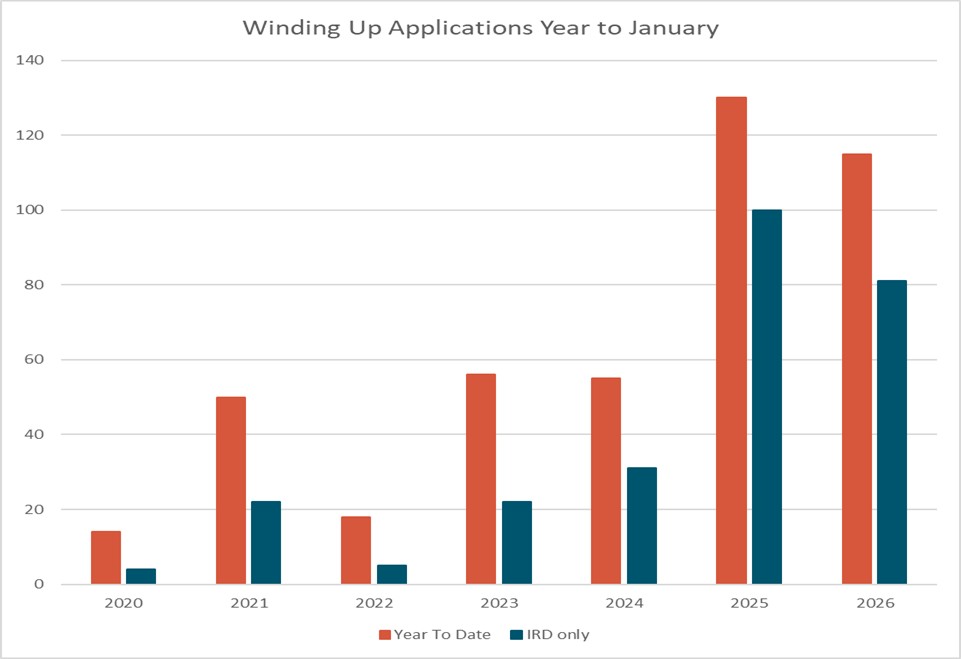
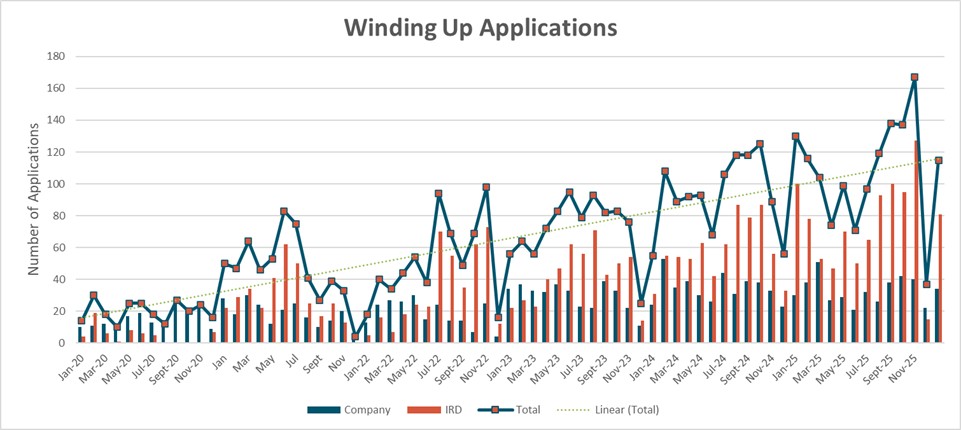
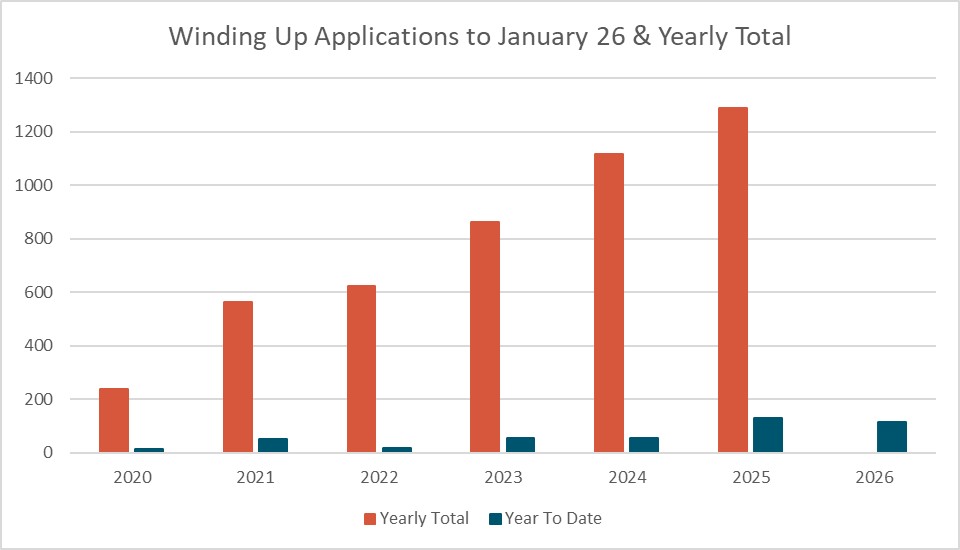
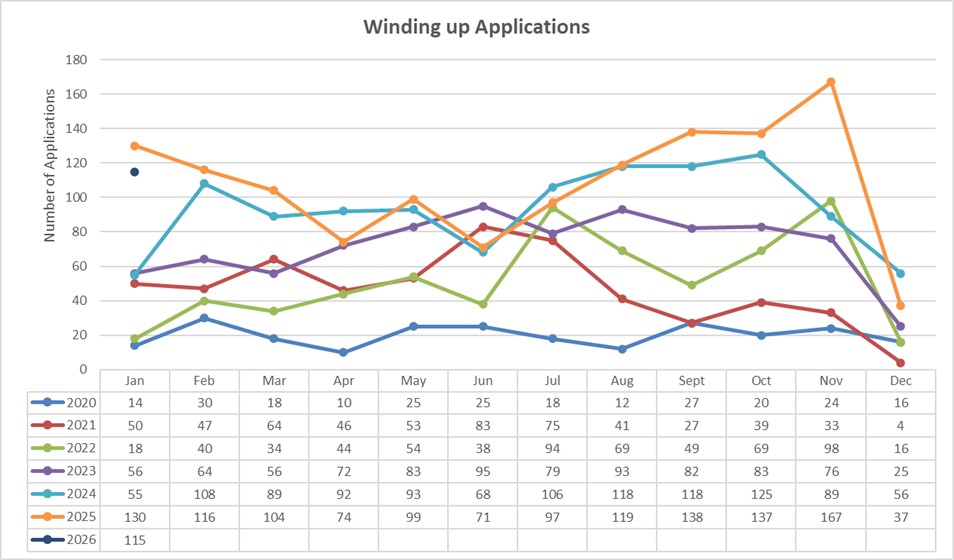
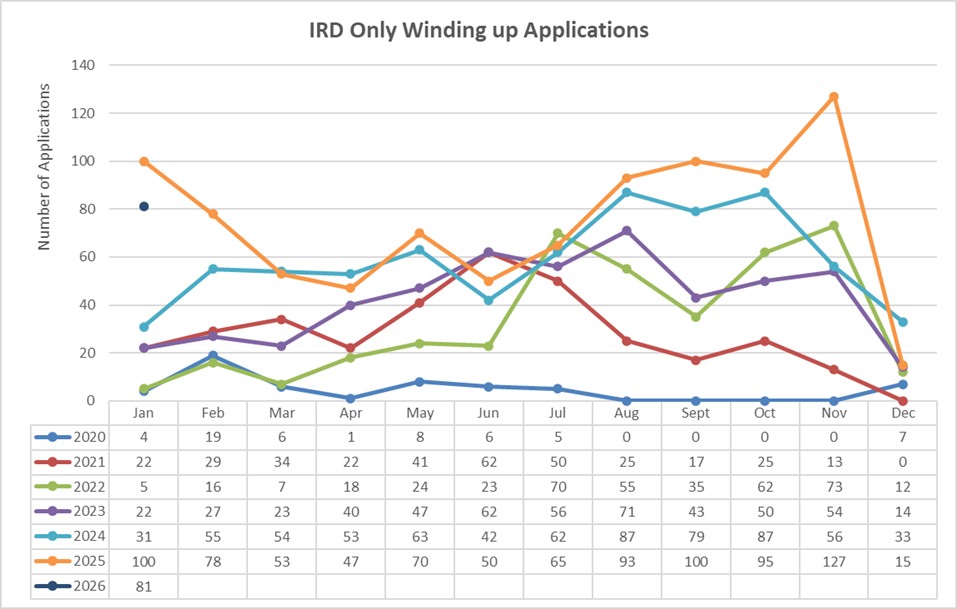
Surprising no one based on how the first 11 months of 2025 were tracking we finished the year with 1289 winding up applications for the year, well above any of the past 5 years and reinforcing that we are yet to see the end of the pressure businesses are facing.
The January monthly total was 115 applications, slightly down on the 2025 total of 130 application. This drop was made up entirely of a reduction in IRD winding up applications from 100 in 2025 to 81 in 2026. Theses application all had February and March hearing dates, so we are expecting to have a busy 2 months to start the year from court appointments.
2026 looks like it will exceed 2024 but may not yet reach the highs of 2025. However, it is very much still early days to predict this.
The big question will be how the November election will play out, and what effect this will have on insolvency appointments. The incumbent government has set the date late in the year to give the economy as much time as possible to have some form of recovery. But with the IRD still sitting on billions of dollars of debt to collect in they may be hard placed to not pursue businesses for what they are owed. It’s a double-edged sword, IRD takes the pressure off and business owners feel less pressure but then the government doesn’t have the recoveries to funds the traditional election year lolly scramble. Whereas if IRD keeps the pressure on business confidence remains in the tank and the recovery takes longer. Its unlikely we will be seeing any further OCR drops with the official stats showing raises in inflation outside the target band and unemployment on the rise particularly in the lower age bands.
December 2025 was the first time in in 32 months where all other creditors applications amounted to more than those advertised by the IRD. I would be hesitant to read to much into this however due to the Christmas close down period December is traditionally a slower month for IRD winding up applications. If this had happened in any other month it may have been worth more of a mention.
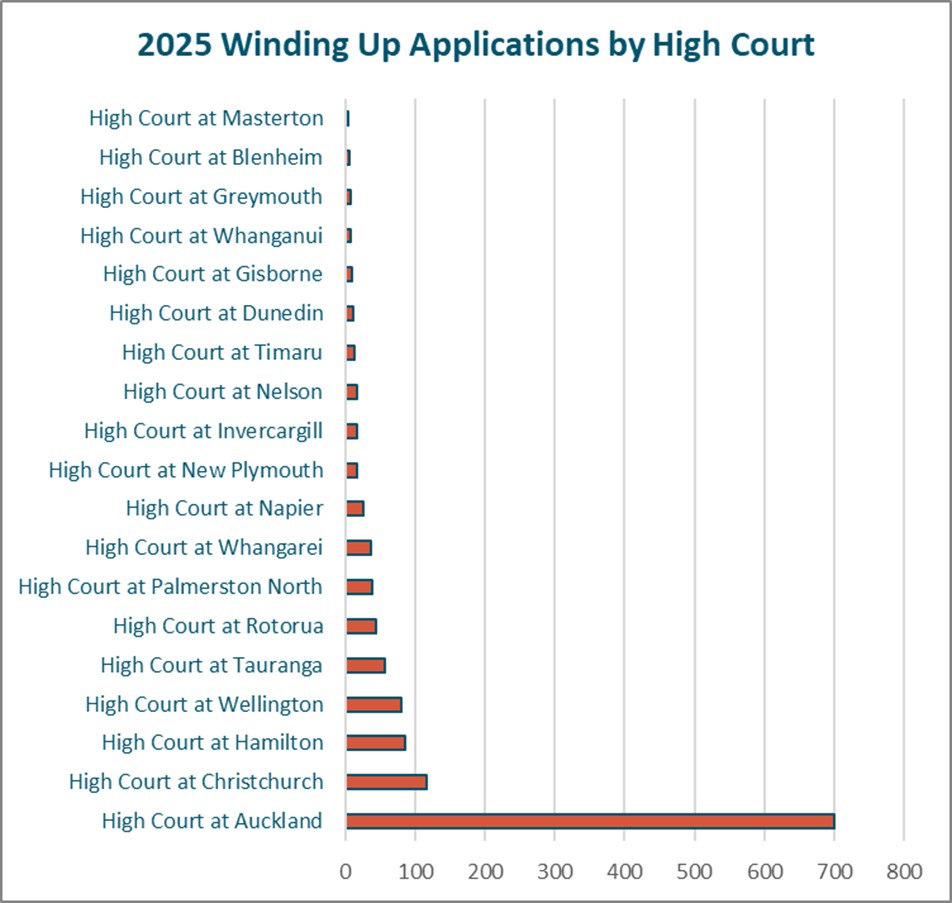
The Auckland High Court dealt with more winding up applications than the rest of the country combined in 2025 700 applications vs 589 applications. That is a fair bit of creditor enforcement and a wide margin between Auckland and the rest of the country,
Being the largest city in NZ by population cap Auckland draws increased business numbers, there will in turn be increased business failures and increased creditor enforcement. Though by population cap Auckland is only 34.14%, making up 54.31% of the winding up applications is still a touch high.
Christchurch sits in the 2nd spot dealing with 116 applications vs 2024 where they say 87, overall, up from 7.79% of the total to 9.00%. Likely a reflection of the slowdown in building work in 2025 post rebuild and all the slowdown in new build developments happening in the region after a few big years of new homes.
Hamilton managed to leapfrog 2024's 3rd place holder Wellington, a combination of Hamiltons increase in applications and Wellingtons applications in 2025 dropping to 72 from 80 in 2024.
Tauranga and Rotorua fill out the top 5 in the same order as 2024.
Notably for the rest of the High Courts Whangarei saw a sizable increase going from 10 applications in 2024 to 36 applications in 2025.
Company Insolvencies – Liquidations, Receiverships, and Voluntary Administrations
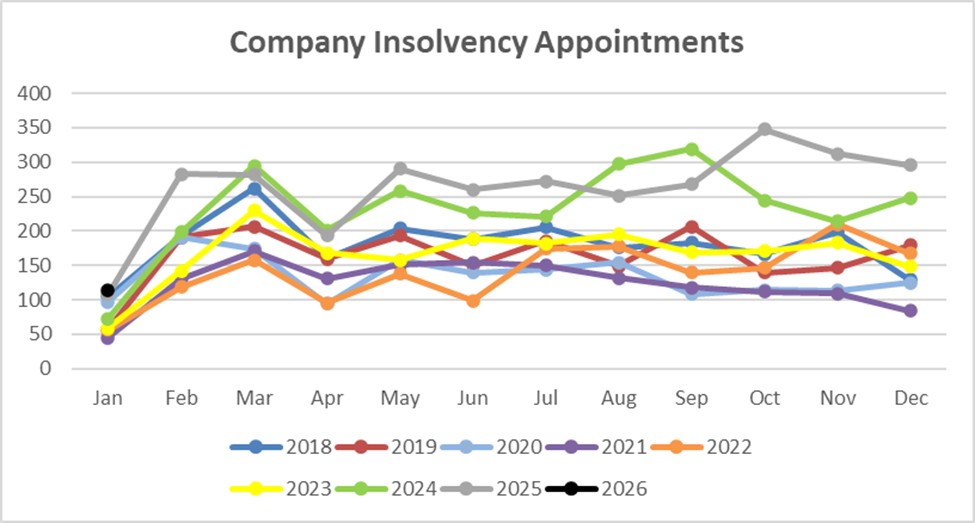
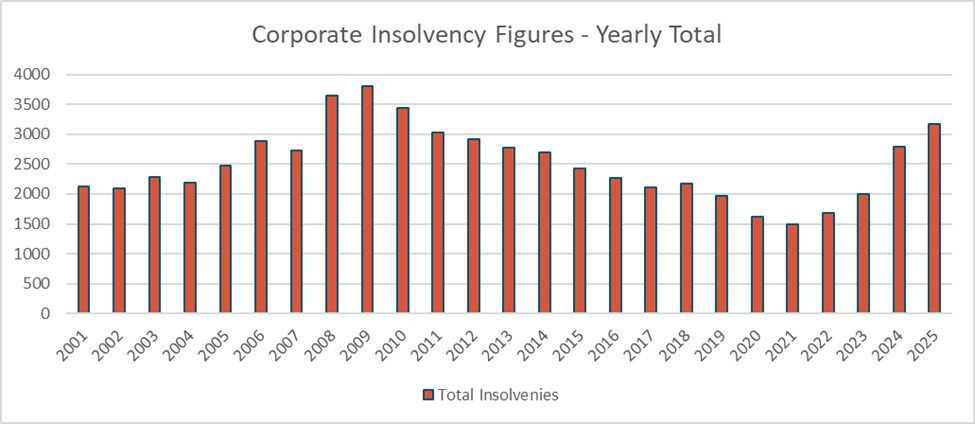
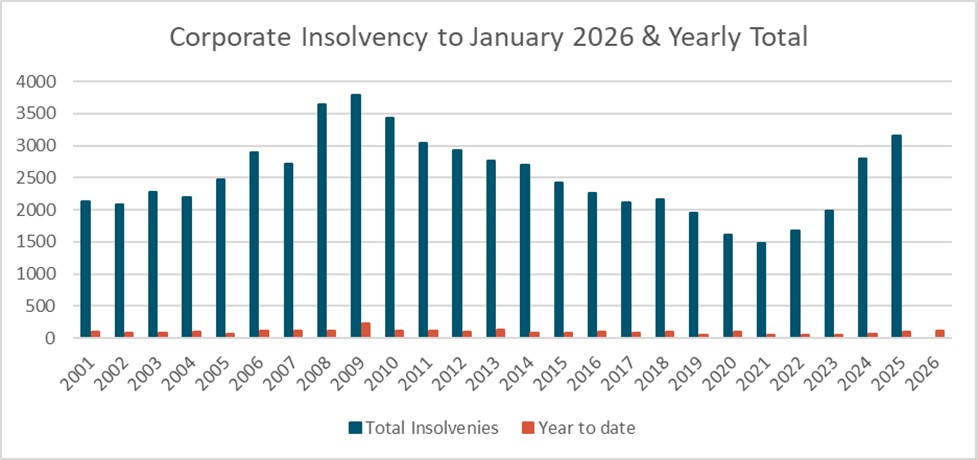
December 2025 finished out a strong year for corporate insolvency appointments, the months was slightly down in 2024 but overall, for the year it ended up around the totals from 2011. So, while a new high for recent years and above the 3,000 predicted last year it is still 600+ appointment down on the 2009 peak.
2025 3,163
2011 3,034
2010 3,438
2009 3,797
2008 3,645
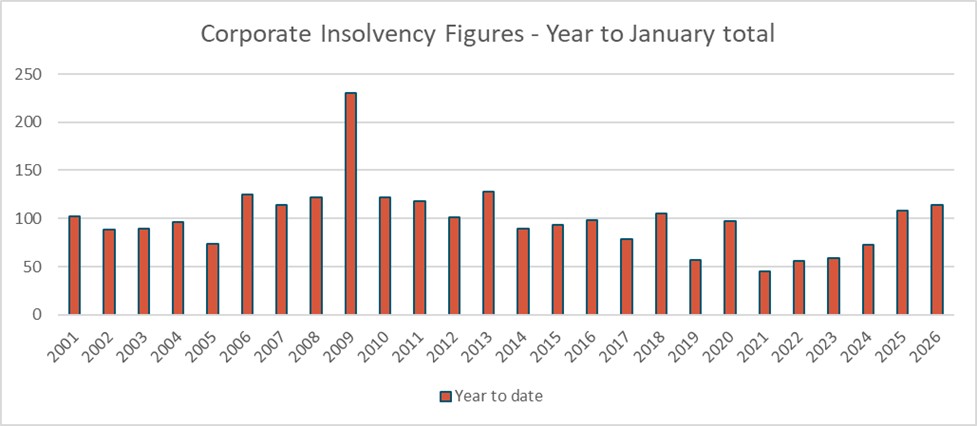
January 2026 on the other hand took off with a hiss and a roar posting 114 appointments in a traditionally quitter month setting the scene for another busy year. While not quite at GFC levels again for January we are still right around the appointment levels seen in the 2009 shoulder years.
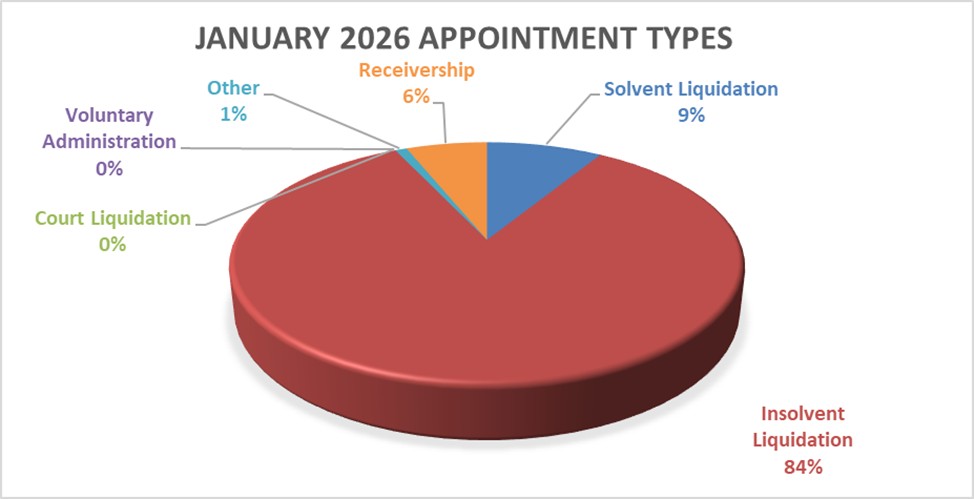
With the high levels of winding up application this month and towards the end of 2025 the number of court appointed liquidations is expected to remain high, however with the courts closed in January shareholder insolvent liquidations made up 84% or 96/114 total for the month with Receiverships and Solvent liquidations filling out the rest. Solvent liquidations continue to remain down on their average but we expect to see them pick up as we head into the end of the financial year.
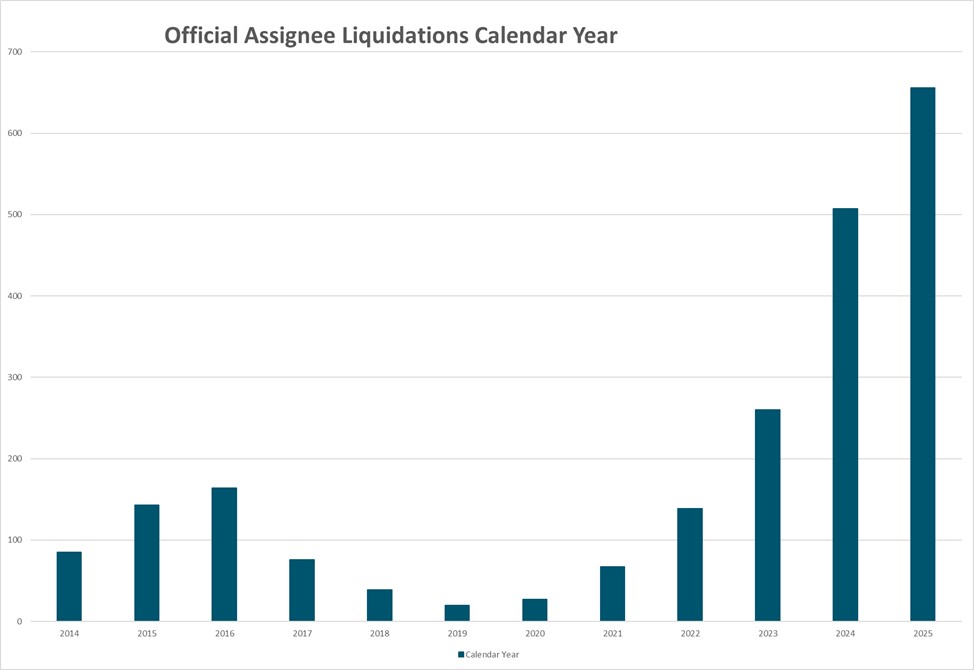
The liquidations taken by the Official Assignee peaked in 2025 off the back of IRD winding up applications. In December 2025 the Official Assignee took 44 of the 76 court appointed liquidations. They continue to be the busiest liquidator in the country.
Personal Receiverships
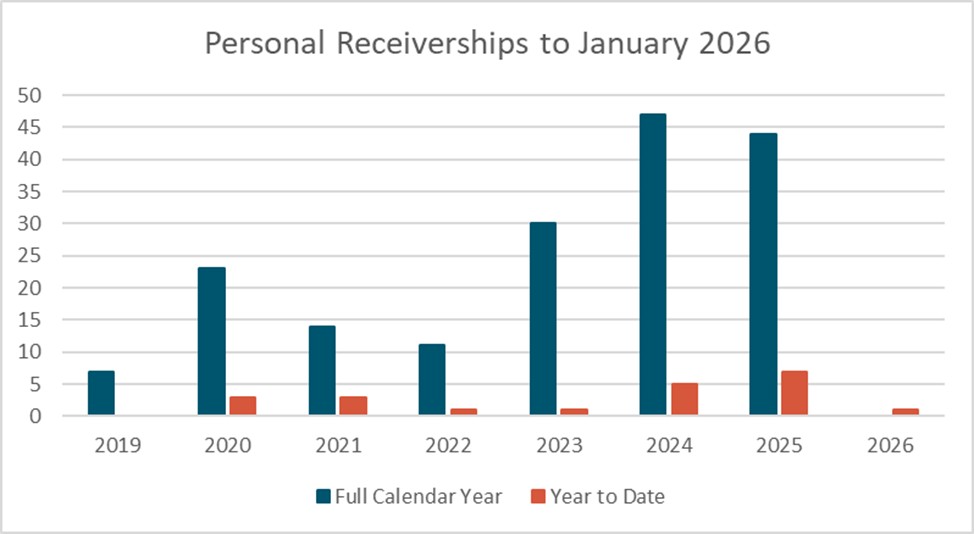
Personal receiverships slowed in the final quarter of 2025 finishing out the year slightly down on 2024. This slowdown has carried through to January 2026 with only 1 new appointment in the month. As corporate insolvencies continue at elevated levels we expect this to pick up over 2026 as companies default the creditors come calling on the stakeholders that have provided security over their personal assets in order to recover something on their debt.
Personal Insolvencies – Bankruptcy, No Asset Procedure and Debt Repayment Orders.
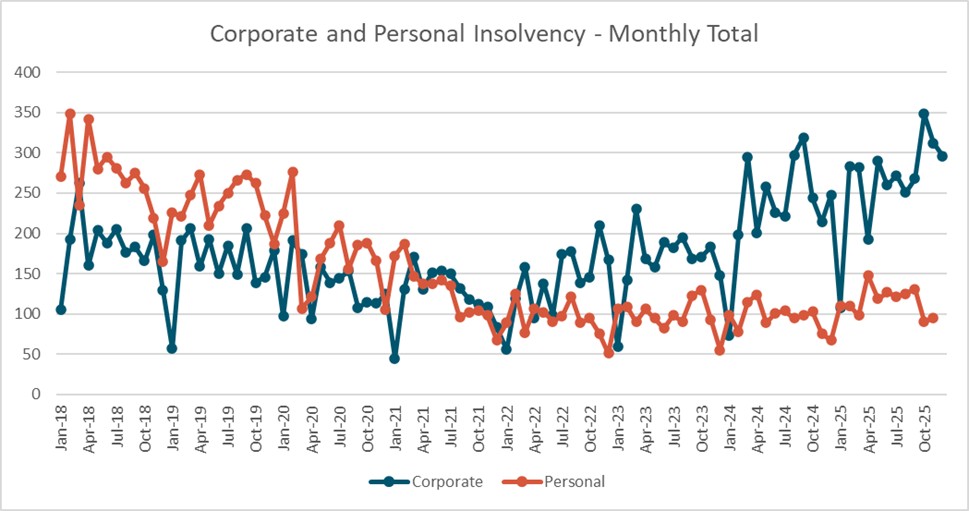
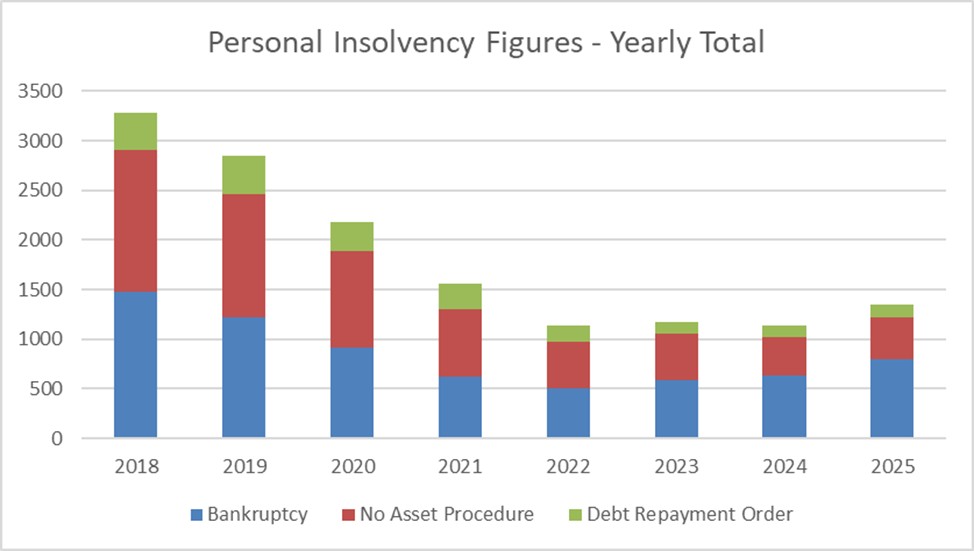
Personal insolvency figures have remained stable at only slightly elevated levels for the 2025 year. When compared to the corporate insolvency levels the two have previously tracked along together while in the last 2 years corporate insolvencies have tracked up while personal insolvency has remained largely flat.
At this point we continue to expect more of the same for the first half of 2026 as we head into the election.
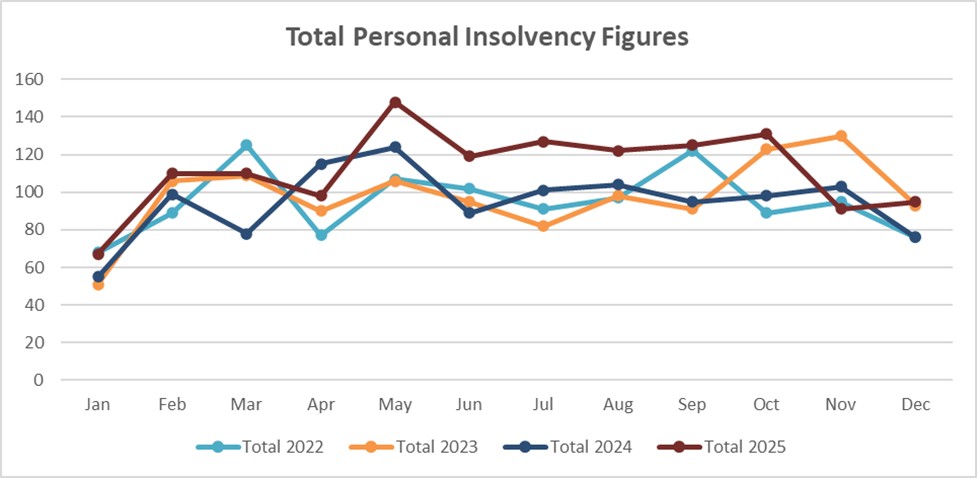
Year on year the 2025 figures were above the last 3 years, while on the increase they remain behind the 2021 figures. This period remains one of the lowest bases for personal insolvency figures.
Where to from here?
2026 will be an interesting year with an election in the tail end, based on 2024 and 2025 insolvency figures appointments should continue to track up. The economy is by no means in the free and clear and has some rough time ahead on the way to recovery. How this plays out with the wait and see approach people take in an election year means the pain may be prolonged and pushed out into 2027.
As always its better to take action and act early, it will often get a better result for all stakeholders.
If you want to have a chat about any points raised or an issue you may have you can call on 0800 30 30 34 or email This email address is being protected from spambots. You need JavaScript enabled to view it..
Solvent Liquidations Explained

Solvent Liquidations Explained
In our experience, one of the most common misconceptions directors and shareholders hold is that liquidation is only relevant when a business is failing. In reality, many New Zealand companies are wound up while fully able to meet all of their obligations. A solvent liquidation is simply a structured and legally robust way to bring a company’s affairs to an orderly close when it has served its purpose.
A solvent liquidation applies where the company can pay all of its debts, including interest, within 12 months. We typically see solvent liquidations where a company has sold its business or has ceased trading, a project or investment vehicle has run its course or a group is simplifying its structure. In these situations, keeping a company on the register often creates ongoing admin and compliance cost along with unnecessary risk.
The distinction from an insolvent liquidation is important. A solvent liquidation is not creditor‑driven, and it is not a sign of financial distress. It is a shareholder‑initiated process designed to settle liabilities in full, finalise tax and compliance matters, and return the remaining asset value to shareholders transparently. Done properly, it provides certainty, protects directors, and delivers a clean endpoint.
The process begins with the director and their advisors undertaking a careful assessment of the company’s financial position and signing a solvency certificate confirming that the company can meet its obligations within the required timeframe. That declaration carries personal responsibility, so it needs to be supported by accurate, current information and a clear understanding of any contingent exposures. Following that, shareholders pass a special resolution to place the company into liquidation and appoint a liquidator. From that point, the liquidator takes control.
In practical terms, the liquidator’s job is to complete the wind‑up efficiently and correctly. That includes advertising the appointment, notifying creditors and regulators, completing outstanding compliance and tax obligations, realising remaining assets where required, paying creditors in full, and distributing the surplus to shareholders. Once reporting requirements are satisfied and the liquidation ends, the company is removed from the Companies Register.
A smooth solvent liquidation relies on preparation. The company must be genuinely solvent and able to meet all known and reasonably foreseeable liabilities, including trade creditors, Inland Revenue obligations, employee entitlements, and any contingent or deferred claims. Clean, up‑to‑date accounting records make an enormous difference: they support the directors’ solvency declaration, reduce cost and delay, and allow the liquidation to progress without complications.
From a director’s perspective, the benefits of a solvent liquidation are often underestimated. First, it provides finality: it closes the door on ongoing filing obligations, annual returns, and the administrative drag of maintaining a dormant entity. Second, it can deliver tax efficiency where distributions through a solvent liquidation are treated as capital rather than income, depending on the company’s tax profile and history. Third, it reduces ongoing cost, removing the recurring accounting, compliance, and Companies Office expenses that accumulate over time. Finally, it provides an additional layer of governance protection through independent oversight, reducing the prospect of later disputes or allegations about how assets were handled or distributions were made.
Timing is also a practical lever. Commencing a solvent liquidation before the end of the financial year can avoid another full cycle of compliance and associated costs, while bringing greater certainty to the year‑end position for shareholders. Just as importantly, acting early reduces the risk that an otherwise straightforward wind‑up becomes complicated by forgotten liabilities, delayed tax filings, or changes in circumstances.
If you are holding a company that has stopped trading, is no longer required, or is simply sitting there with retained value and no clear purpose, it is worth addressing it proactively rather than leaving it to drift. If you would like a confidential, no obligation discussion about whether a solvent voluntary liquidation is appropriate, and how to time it before financial year end, get in touch. A short upfront review can clarify solvency, identify any risks early, and map out a practical pathway to an efficient, compliant wind‑up.
Incorporated Societies: the April 2026 cliff edge under the Incorporated Societies Act 2022

Incorporated Societies: the April 2026 cliff edge under the Incorporated Societies Act 2022
From 5 April 2026, every society still on the register under the Incorporated Societies Act 1908 must have made a deliberate choice: re‑register under the Incorporated Societies Act 2022, wind up properly, or accept that it will be struck off and will cease to exist as an incorporated society. The Companies Office has been clear that re‑registration is not automatic and that societies that miss the deadline will simply no longer exist in their incorporated form.
If your society does nothing, it stops existing
If your society takes no action by 5 April 2026, it will be removed from the register and will no longer have a separate legal identity. That matters because incorporation is what separates the society from the individuals running it. Once that protection is gone, the people continuing to act for the group may be exposed in their personal capacities to the society’s existing obligations, and the group’s ability to hold property or enter and enforce contracts in the society’s name is compromised. This is not a technicality it will affect contracts, leases, funding arrangements, employment agreements and insurance, and it can turn what used to be “the society’s problem” into a personal problem for those involved.
Losing incorporation also affects control. If a struck‑off society still has assets, the society may no longer be able to make decisions about how those assets are dealt with and the Registrar may need to direct the distribution where the society is no longer able to do so itself. And once a society is deregistered, its name is no longer protected, meaning another group can register under the same or a similar name.
If you do not reregister but want to keep operating, you will a new IRD number as it will lose its legal status as an incorporated body and will be treated as a new entity for tax purposes. If you were registered for GST or as an employer, the registrations will have to be transferred and you will need to reapply for any income tax exemption or deduction as a not-for-profit.
What re‑registration requires (and why leaving it late is risky)
Reregistering under the 2022 Act | Incorporated Societies
The Incorporated Societies Register has a comprehensive guide on how to re-register and what is required. It will take time, particularly for volunteer organisations that meet infrequently or have seasonal AGMs, so with the deadline looming the time to act is now whether you plan to reregister or fold.
Non‑compliance can create personal exposure for officers
The 2022 Act also raises expectations of governance. Officers’ duties are set out more explicitly and, in serious cases, the Act includes offences that carry substantial penalties. For example, where there is dishonest conduct around incurring debt while insolvent, the Act provides for penalties up to five years’ imprisonment and/or a fine up to $200,000. This is not aimed at ordinary volunteers acting carefully and in good faith, but it underlines why societies that are struggling, inactive, or carrying unresolved liabilities should not drift past the deadline.
If you are not going to re‑register, wind up on your terms
Some societies will decide that re‑registration is not worthwhile. Membership may have fallen away, the purpose may have been achieved, or there may simply be no appetite to do the governance work required. In that situation, the worst option is to do nothing and lose control of the process. The sensible options are to apply to be dissolved if the society has genuinely finished and has dealt with its assets and liabilities, though this can be objected to, or to appoint a liquidator where there are debts, assets to realise, contractual commitments, or a need for an orderly closure.
Liquidation is not only for financial distress. It is often the cleanest way to close a society that has assets, creditor claims, or messy loose ends, because it creates a single controlled process for collecting in assets, dealing with creditors, terminating obligations where possible, and completing the statutory steps to remove the society from the register.
An incorporated society can be placed into liquidation by its members, or by the High Court.
Liquidation by a society’s members
To place a society into liquidation, its members must follow a set process. Firstly, they must resolve at a general meeting to appoint a liquidator. In doing so, the society must follow the procedures set out in its rules. The resolution to appoint a liquidator must be confirmed at a second general meeting, called specifically for that purpose, and to be held not less than 30 days after the first meeting. A liquidator (or liquidators) can then be appointed.
Liquidation of Charities or Not for Profit’s - McDonald Vague Insolvency
Liquidation by the High Court
The Registrar, a society member, or a creditor may apply to the High Court to have a society put into liquidation.
An application can be made for a number of reasons. The society has suspended its operations for 1 year or more, the number of members has fallen below 15, the society is unable to pay its debts, the society is undertaking activities from which individual members are making a pecuniary gain, contrary to the Act or finally any other circumstances which a High Court judge considers acceptable.
How we can help
If your society is unlikely to re‑register, the key is to act early enough to choose the right pathway and to keep the decision‑making with members rather than having outcomes dictated by a strike‑off. McDonald Vague can advise on whether dissolution is appropriate or whether a formal liquidation is the safer route, and where liquidation is needed we can act as licensed insolvency practitioners to manage the wind‑up efficiently and properly.
If you are unsure whether your society will re‑register by April 2026, talk to us now. Early advice can prevent personal exposure, protect assets, and ensure the society is closed in an orderly way rather than simply ceasing to exist overnight.